Showing posts with label Venus. Show all posts

Sunday, April 6, 2008

2nd Mounykhion

Moon in Aries: Today Selene and Demeter are in the zodia of Aries, which means that we need to be aware of what they are telling us. The Moon in Aries has the positive effects of allowing us to experience, according to which topos - or house - Aries occupies in our birth charts, strong emotional responses, the ability to react and respond to stimiuli and events, and the ability to change behaviour and habit patterns. The negative effects of The Moon in Ares are that we may be more impatient and irritable than usual - as our feelings and emotions are in danger of being affected by Ares, the God of Conflicts and Struggle.

Today it is important to identify when we want to be short or irritable with others, and then try to temper that with the kindness and understanding of Selene and Demeter. This mindfullness will help us to use the creative energies of this aspect between the Gods to our advantage.

Venus in Pisces: Let's learn what this powerful combination of Planet and Zodia means for us in light of Hellenic Paganism and Astrology; this placement encourages us to be loving and sympathetic to those around us. When Aphrodite is found in Pisces, she encourages us to do or make something artistic, musical, or otherwise creative. This is a time when we can call upon the Goddess, and the Muses along with her, to help us give birth to acts of art, beauty, creativity, and unconditional love. Venus in Pisces is a time in which we are called to serve others and to provide inspiration to those who need comforting and encouragement.

Venus in Pisces can have some negative effects however, and we must be on the guard against these excesses: seeking egotistical or narcissistic ends in serving others - as in helping others merely to recieve kudos or accolades, seeking to find spiritual comfort and fulfillment through merely physical or romantic relationships, self-deceiving ourselves in our relationships (not just romantic, but all relationships!), self-pitying, and a feeling of "poor me" during this aspect. People who have personality disorders are apt to be particularly unbalanced and/or neurotic during Venus in Pisces, as it is a particularly powerful Zodia for the Goddess to inhabit.

Venus in Pisces is square Pluto Retrograde in Sagittarius: This aspect, even though it is a square or quartile, is a good one for us as Hellenic Pagans to learn from. Modern astrology has given some aspects, such as squares and oppositions, a bad wrap. Let's review the properties of squares in Hellenic thought before we discuss the properties of this particular aspect.

Squares/Quartiles:

  • the planets involved are separated by three zodia and topoi (or 90 degrees)
  • the planets involved share the same modality, but have different elements and polarity
  • this aspect represents the Platonic form of the square


This means that Aphrodite in Pisces is in a Zodia that is feminine, fruitful, flexible (also called common), of short ascention (in the Northern Hemisphere), watery, and serving. This is in full harmony with the nature of Aphrodite, and allows her to express herself fully, without conflict or restraint. Pluto in Sagittarius is also in a Zodia that is especially compatable with his nature - his Zodia is masculine, fruitful (a powerful placement for Chthonian dieties), reproductive, flexible, of long ascention (in the Northern Hemisphere), fiery, energetic, bicorporeal and ambitious.

This is a good aspect - despite how "modern astrologers" view it, as both Gods involved are acting comfortably within their respective Zodia while complementing each other in terms of elements and polarity. This aspect is the Gods' way of telling us that we are entering a time when we can all work together to effect change in cultural and religious awareness, social justice issues, and public policy.

From the Gods' places in the skies to our lives!

Saturday, February 9, 2008

Aphrodite in modern and ancient culture

4 Anthesterion, 2784
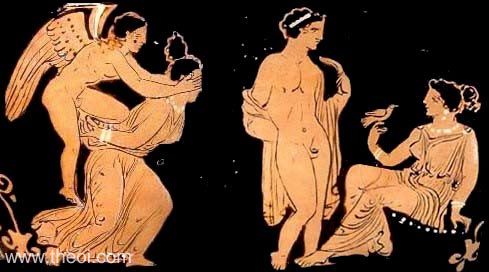
Aphrodite, Eros and Lovers, from http://www.theoi.com/Gallery/K32.6.html


Today is the fourth day of the Lunar Calendar, and it is sacred to Hermes, Aphrodite, and Eros.


Aphrodite is an interesting, but often misunderstood Goddess; she may be more popular in modern culture under her Roman name of Venus.
There are multiple versions of Aphrodite's birth in extant texts and literature. This is common in the Ancient Greek and Roman Religions where there was no such thing as "orthodoxy" or only one, right way of thinking; rather, "orthopraxy" or right living and right conduct were what followers of the Olympians strived for.
Having a relationship with the Olympians is in many ways different from the way that many modern monotheists concieve of having relationship with the numinous. Most people worshipped all of the Olympians, but had a special devotion or following for a particular patron diety. This patron God often had a personal, special relationship with his or her followers, and helped them in thier daily lives; the patron God could be worshipped by an individual, a family, or even a whole city.
Different regions had different rituals, offerings, and relationships with the Gods during different periods of history. This allowed for an organic and adaptable faith - there was no rigidity in worship or lived practise, as the Gods understood human being's need for social, cultural, and religious evolution. We can see how cultural change affected worship of Aphrodite in both Greece and Rome.
Hesiod in Theogony 176-178 states that her birth happened in this way:

. . . and so soon as he had cut off the members with flint and cast them from
the land into the surging sea, they were swept away over the main a long time:
and a white foam spread around them from the immortal flesh, and in it there
grew a maiden. First she drew near holy Kythera, and from there, afterwards, she
came to sea-girt Kypros, and came forth an awful and lovely goddess, and grass
grew up about her beneath her shapely feet. Her gods and men call Aphrodite, and
Aphrogeneia (the foam-born) because she grew amid the foam, and Eustephanos
(well-crowned or girdled) Kythereia because she reached Kythera, and Kyprogenes
because she was born in billowy Kypros, and Philommedes (Genital-Loving) because
sprang from the members. And with her went Eros (Love), and comely Himeros
(Desire) followed her at her birth at the first and as she went into the
assembly of the gods.

This makes the birth of Aphrodite similar in nature to that of Athene - she is born of the ruling God only (actually through Ouranos' castration and subsiquent removal from power), with no input from a Goddess or female force.
In Hesiod's version of the myth, Aphrodite is born of the male principle, and only of the male; note how the Ocean which carries her has no part in her birth, but merely takes her to Cythera and Cyprus. She is transported by the feminine element of water to a place of dry land - this is why her very nature is both fully emotional and fully grounded at the same time. There is not a conflict over experiencing emotions and being overcome by them. Aphrodite illustrates the ability to fully experience one's emotions while at the same time not being ruled by them. Nor does she conform to the feminine cliche of an overly emotional, weak woman, but rather is an example of stregnth in femininity - much like Athene. This is different from how she is sometimes shown in modern pop culture.
Another story of the birth of Aphrodite can be found which states that she was born of a relationship between Zeus and Dione. This seems to come from the fact that Aphrodite and Dione both had temples in the sanctuary of Zeus at Dodona. Homer, in both the Illiad and Odyssey gave this as the birth story of Aphrodite, so even though it seems to have not been as widely believed (based upon textual citations and worship centers) it is a belief that has a long tradition.
Some modern scholars (such as Morford and Lenardon) feel that these two different stories show the existence of two different, completely seperate Goddesses. They state that Aphrodite Urania, who is also called The Celestial Aphrodite by her worshippers, is represented in the Hesiodic tradition. She springs from Uranus "alone, ethereal, and sublime". This is contrasted with the Homeric tradition which calls her Aphrodite Pandemos or Aphrodite of all the People.
Plato, who knew of both of these personalities or representations of Aphrodite, discussed them in his Symposium and explained the differences between the two Goddesses. He stated that Aphrodite Urania was older, stronger, and much more intelligent than the Homeric Aphrodite. She was also much more spiritual in nature and this is what likely lead to her greater worship than the Hesiodic Aphrodite.
Aphrodite Pandemos is often described merely in contrast to Celestial Aphrodite - she is shown to be associated with physical attraction and procreation whereas Celestial Aphrodite is The Celestial Goddess of pure, spiritual love. This distinction formed a very powerful archetype upon which Ancient Greece and Rome were built - the distinction between holy and profane love.

These myth traditions passed into the Roman Religion, where they were all taught by Cicero as follows, when he is enumurating a number of different - even rival - cult traditions about Aphrodite from different regions :

The first Venus [Aphrodite] is the daughter of Caelus [Ouranos] (Sky) and Dies [Hemera] (Day); I have seen her temple at Ellis. The second was engendered form the sea-foam, and as we are told became the mother by Mercurius [Hermes] of the second Cupidus [Eros]. The third is the daughter of Jupiter [Zeus] and Dione, who wedded Vulcanus [Hephaistos], but who is said to have been the mother of Anteros by Mars [Ares]. The fourth we obtained from Syria and Cyprus, and is called Astarte; it is recorded that she married Adonis.

(Cicero, De Natura Deorum 3. 21 - 23)


As we move closer to the secular public holiday of "love" here in the US, it might help us to remember who Aphrodite really is and what she stood for in the Ancient Greek and Roman Religion; here is a link to extensive information on her worship in the Ancient Greek World.