Showing posts with label Greek. Show all posts

Wednesday, April 2, 2008

April Evening Sky Watch

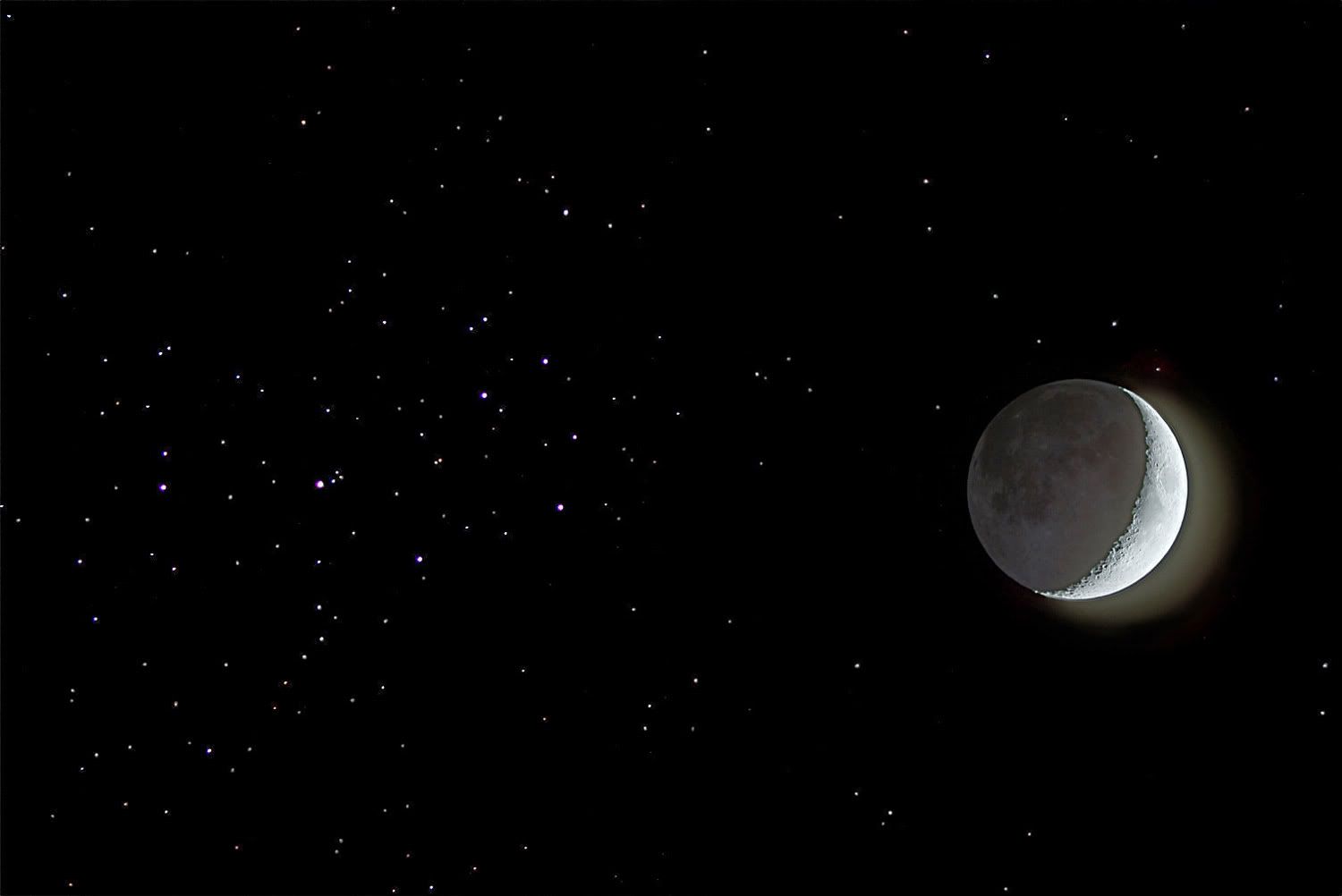
If you go outside about an hour after sunset on the evening of Tuesday, 8th of April, you will see a conjunction between the Crescent Moon and the Pleiades. It will look similar to the following picture (although the sky will be less dark):
:: ::
Astronomy.com recommends using binoculars to look at the moon and the star cluster. Below is a star chart (also from Astronomy.com) that should help you to locate the conjunction for viewing through binoculars or a telescope. The Moon and The Pleiades are both found within the constellation of Taurus, which will be hovering around the horizion after nightfall.
::
::
Ptolemy states that the Pleiades have the "qualities of the Moon and Mars mixed together"; this means that we should understand the Pleiades as representing facets of both Demeter and Mars.
This is an interesting conjunction, as it is telling us that we need to process our feelings and emotions dealing with violence, war and oppression. It is no coincidence that today the Pentagon stated it will be reducing tours of duty for tours in Iraq to 12 months instead of the current 15 months while Bush promised yet more troops for support of the Occupation of Afghanistan. How is this possible in a military force that is already stretched to its limits? Will troops who leave Iraq be sent to Afghanistan for another hellish tour? It will be interesting to see how this plays out - especially in light of Ares' and Kronos' places in the zodia.

This conjunction also tells us that we should find balance between action and feeling in response to events in our lives - this is a time for us to stop and ask ourselves if what we are getting angry about is really what is making us angry. Are we really angry at the person who jumps the queue ahead of us - or are we angry that some people think the rules just don't apply to them? Ask Selene, Demeter and The Pleiades to help you learn how to balance your emotions (including anger!) and actions, so that neither rules your life. It is best for a person to know what they are feeling and what they can do with that feeling to effect change in the world around them.

Some other Planets to look for when skygazing:

On the 15th of April, the Gibbous Moon will be directly beneath Saturn in Leo. The Moon and Saturn will be especially close to α Leonis, which is called in ancient Greek Astrology the heart of the lion.

Mars is currently an evening star - look for him in Gemini shining a bright red. On the evening of April 11th and 12th, be sure to look in Gemini, as the Moon will pass 1.2 ° north of Mars.

Mighty Saturn is currently in Leo, where he shines all the way until Eos' rosy rays shine in the East. It will be easy to recognise Saturn, as he is shining at magnitude 0.4 - or 2.5 times brighter than the brightest star in the entire constellation of Leo! (Regulus or α Leonis shines at 1.35 apparent magnitude). Saturn will be particularly beautiful to behold on the 22nd, when the Lyrid meteor shower will peak in the early morning hours. (I will blog later about what I think the Lyrid meteor shower and the Moon's Void of Course on the 22nd have to say about the PA Primary!). Saturn will close out the month due south, having its ascendency at twighlight.

On the evening of the 28th and 29th, Mars will pass 5 ° south of Pollux (β Geminorum) - a fixed star which portends well. The following is a quote from Manilius on β Geminorum:

From the Twins come less laborious callings and a more agreeable way of life,
provided by varied song and voices of harmonious tone, slender pipes, the
melodies inborn in strings and the words fitted thereto : those so endowed find
even work a pleasure. They would banish the arms of war, the trumpet's call, and
the gloom of old age : theirs is a life of ease and unfading youth spent in the
arms of love. They also discover paths to the skies, complete a survey of the
heavens with numbers and measurements, and outstrip the flight of the stars:
nature yields to their genius, which it serves in all things. So many are the
accomplishments of which the Twins are fruitful.

(Manilius, Astronomica, 1st century AD. p.281)

Mars will close the month of April in proximity to both Castor and Pollux (this will last about a week).

Sunday, February 10, 2008

The Goddess Tyche and the Part of Fortune

5 Anthesterion, 2784

Today is sacred to the Erinyes(the Furies), Nemesis, Dike, Melinoe, and the Horkos.

Tyche has been described by scholars as "the most important diety of the Hellenistic era because of her universal sovereignity over mortals and immortals alike"(22). As Luther Martin points out in his book Hellenistic Religions: an introduction, "a personified Fortune (Tyche) was widely worshipped by the third century BCE and possessed temples in nearly all the great Greek cities"(Martin, 22). The development of belief in Tyche, who embodied both positive and negative aspects, shows the growth of a system of ethics within Greek faith and practise.

The universal recognition of Fortune's effects is often viewed in light of what Pliny described as "the final stage in the secularization of Hellenisitc religion, in which the personification of the unpredictable and the unexplained 'take the place of God' "(22). Random and unexplicable events of life were not the result of punishment from Zeus or the other Olympians, but rather an aspect or person of the Numinous itself.

The Goddess Tyche

Tyche, which is the Greek name for this goddess, is sometimes used (especially in late Greek and Roman times) for the soley negative aspects of the Goddess - such as chance, flukes, randomness, unsteadiness, and sheer luck. During later periods, her positive aspects are given the name Eutykhia, who embodies only good fortune, luck, success, and prosperity. While they are seen as two seperate manifestations, they are always seen as a single, united Goddess.
The feelings and emotions that were associated with Tyche or Fortuna in the ancient religion are represented by the Part of Fortune in horoscopes. Looking at the placement of this lot was well known and widespread by the 1st century BCE, and was likely in widespread use for decades, if not centuries prior to the extant records we have available archaeologically. It is unknown if this lot was Hellenic, Babylonian, or Egyptian in origin, as it appears in the Astrologies and religions of all three civilizations in ancient times.

Calculating the Part of Fortune is relatively easy, especially with the aid of modern Astrological software and calculation programmes. The way to calculate this lot is based on whether the birth occured during the day or during the night:

Day chart: Ascendant + Moon - Sun
Night chart: Ascendant - Moon + Sun

Notice that for a chart where the sun is above the horizion (i.e. in the seventh through the seventh through the twelfth houses) the Moon has a positive effect while the Sun has a negative effect; for a nocturnal chart, the opposite is true.

While one's destiny is written by the Gods, the way that one goes about achieving this destiny is what determines the individual's fate. Some people today make the mistaken assumption that if one has a destiny given to them by the Gods, that they have no free will. This is not the case, as one can choose to either accept or deny their destiny and divine calling of their own free will. If one accepts their destiny and practices orthopraxy - or right living in harmony with the Gods and their wishes - then they are virtuous and have good luck. If one tries to deny their destiny or falls out of favour with the Gods through hubris or wrong decisions, then they will experience bad luck or punishment for their deeds. As Martin states, in the Ancient Greek world:
Whereas one could not escape the positive or negative effects of the moira, one might be saved from domination by a negative Tyche/Fortuna through sympathetic identity with her positive side (25).